
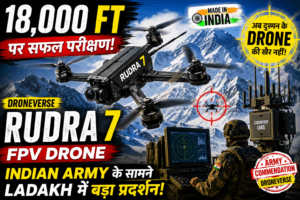
India’s push to build a modern, self-reliant drone warfare ecosystem has received another significant boost with a high-altitude demonstration by Gurugram-based defence technology company DroneVerse. In a major field trial conducted before Indian Army officials in Leh, Ladakh, the company successfully showcased its Rudra 7 FPV combat drone along with its Counter-Unmanned Aerial Systems (C-UAS) capabilities at altitudes reaching 18,000 feet. The demonstration is important not only because of the systems involved, but also because of where it took place: the extreme terrain and weather conditions of Ladakh represent one of the toughest operating environments for unmanned platforms anywhere in the world.
For India’s military planners, high-altitude regions such as Ladakh are strategically sensitive and operationally demanding. Thin air, low temperatures, turbulent winds, and reduced atmospheric pressure can severely affect the performance of drones, sensors, batteries, motors, and communications links. A system that performs well in plains or desert conditions may struggle badly in the mountains. That is why a successful demonstration in Ladakh carries much more weight than a routine test at lower altitudes. It is a direct indicator of whether a platform can contribute to frontline operations in one of India’s most challenging military theatres.
Why the Ladakh Trial Matters
Ladakh has become one of the most important testbeds for India’s future warfighting technologies. The region combines altitude, difficult weather, complex terrain, and operational urgency. Military units deployed there need surveillance, rapid targeting, logistics support, and defensive tools that can work reliably despite harsh conditions. In recent years, drones have become central to all of those missions.
The global battlefield has also changed dramatically. Modern conflicts have shown that small, low-cost drones can have outsized battlefield impact. FPV drones, loitering munitions, and swarm systems are now used for reconnaissance, artillery correction, direct strike missions, infrastructure attacks, and harassment of troop positions. At the same time, defending against hostile drones has become just as important as deploying one’s own unmanned systems. This is exactly where DroneVerse’s Ladakh demonstration becomes relevant: it brought together an offensive FPV strike platform and a defensive anti-drone solution in the same operational context.
The Rudra 7 FPV Drone: Built for Frontline Assault Roles
The headline system in the demonstration was DroneVerse’s Rudra 7, a First-Person View combat drone designed for frontline missions. FPV drones are valued in modern warfare because they can be flown with high precision, at low cost, and with a mission profile that can be tailored to battlefield needs. Depending on configuration, they can be used for surveillance, strike simulation, payload delivery, or attack missions.
According to the demonstration details, the Rudra 7 was tested in the rarefied atmosphere of Ladakh and showed stable flight control, precision handling, and sustained reliability. That is a notable achievement because high-altitude operations impose heavy aerodynamic penalties. Lower air density reduces lift and affects motor efficiency, while freezing temperatures can influence battery performance and onboard electronics. For a drone to remain manoeuvrable in such conditions, it needs careful design in propulsion, tuning, weight distribution, and control software.
DroneVerse appears to have focused on precisely those factors. The Rudra 7 reportedly uses advanced propulsion tuning and adaptive flight algorithms that help maintain manoeuvrability even when air pressure drops. During the demonstration, the drone carried out high-speed vertical climbs, precision strike simulations, and real-time live feed transmission. These are not cosmetic showpieces; they are mission-relevant tasks. Vertical climbs matter when drones need to rapidly gain height over ridgelines or avoid obstacles. Strike simulations test the drone’s ability to approach and engage a target accurately. Live feed transmission is essential for battlefield awareness, target confirmation, and decision-making.
The Indian Army is understood to have evaluated the platform on operational parameters such as payload carriage, targeting consistency, and blast radius control. In practical terms, these are among the most important questions a military user would ask. How much payload can the drone carry at high altitude? Can it remain stable enough to place that payload precisely? Can it be trusted to perform consistently in repeat missions rather than just one successful flight? A drone intended for combat use must answer all of these questions positively before it can move beyond the demonstration phase.
Design Features That Matter in Mountain Warfare
The Rudra 7 is particularly relevant because it has reportedly been designed with frontline assault missions and swarm compatibility in mind. That suggests a platform intended not just as a one-off experimental drone, but as part of a broader tactical concept. Swarm-capable or swarm-compatible drones can be deployed in numbers to overwhelm enemy positions, saturate defences, or create confusion on the battlefield. Even if the Rudra 7 is not fielded in very large numbers immediately, designing it with that possibility in mind is strategically important.
Another notable feature is its modular payload slot architecture. Modular payloads allow the same drone platform to be adapted for different roles. One configuration may carry a surveillance package, while another may carry a warhead or a mission-specific payload. This flexibility is especially valuable in remote, high-altitude deployments where logistics are difficult and commanders prefer multi-role systems over single-purpose equipment.
The drone’s lightweight carbon-composite airframe is also worth attention. Weight is a major constraint for high-altitude drone operations. A lighter airframe can improve agility, reduce strain on propulsion, and help offset some of the penalties of thin air. Combined with electronic stabilisation, such a design can help the drone remain usable in mountain winds and rugged terrain where traditional systems may lose efficiency or control.
Counter-UAS Systems: The Other Half of the Drone Battlefield
DroneVerse did not limit the Ladakh event to offensive FPV drones. The company also demonstrated its Counter-UAS systems, which are intended to detect, track, and neutralise hostile drones. This is a critical capability because the drone revolution cuts both ways. If India can use FPV drones, surveillance drones, and loitering munitions for tactical advantage, its adversaries can do the same. Small hostile drones can threaten forward bases, ammunition dumps, logistics convoys, radar positions, and troop concentrations.
In this context, counter-drone systems are no longer optional accessories; they are rapidly becoming an essential layer of battlefield defence. A modern C-UAS architecture typically combines detection, tracking, identification, and neutralisation. Depending on design, it may use radar, electro-optical sensors, radio-frequency detection, jamming, spoofing, or hard-kill methods to stop incoming drones. While specific technical details of DroneVerse’s system were not fully disclosed in the demonstration summary, the broad purpose is clear: to give frontline units the ability to defend themselves against hostile unmanned threats.
The significance of demonstrating FPV drones and C-UAS together should not be overlooked. It reflects a more mature understanding of modern warfare. Drone warfare is no longer about simply buying a few reconnaissance UAVs. It is about building a layered ecosystem in which strike drones, surveillance drones, loitering munitions, counter-drone defences, and training systems all operate as part of one battlefield network.
Recognition from the Indian Army
One of the strongest signals from the Ladakh demonstration was that DroneVerse received an Army Commendation for Innovation and Technical Excellence. Such recognition does not automatically guarantee procurement, but it does indicate that the Army sees the effort as meaningful and operationally relevant. In the defence technology ecosystem, this kind of validation matters. It tells investors, engineers, and policymakers that indigenous companies can produce systems worthy of military evaluation in demanding conditions.
The commendation also fits into a broader pattern in which the Indian Army has been increasingly open about its future unmanned requirements. In recent months, the Army has publicly outlined technology roadmaps for unmanned aerial systems and loitering munitions, reflecting how central drones have become to future force planning. A successful high-altitude trial by an Indian company therefore arrives at a time when the military is actively looking for scalable, adaptable, and indigenous solutions.
What Comes Next for Rudra 7?
The successful trial does not mean the Rudra 7 is immediately headed for large-scale induction, but it does move the platform closer to that possibility. DroneVerse has indicated that the demonstration could pave the way for extended endurance upgrades and autonomous navigation improvements. These are logical next steps. Endurance matters because drones that can remain in the air longer offer greater flexibility for surveillance and strike missions. Autonomous navigation is increasingly valuable in contested environments where signal disruption, jamming, or terrain masking may complicate remote piloting.
If subsequent validation trials and operational clearances go well, the Rudra 7 could become a candidate for mass production under India’s Make in India defence push. This would be significant for several reasons. First, it would reduce reliance on imported platforms for certain tactical roles. Second, it would strengthen domestic manufacturing and supply chains. Third, it would create an iterative loop in which military feedback directly shapes future indigenous drone development.
The Strategic Importance of Indigenous Drone Capability
The broader significance of DroneVerse’s Ladakh demonstration lies in India’s long-term pursuit of defence self-reliance. Drones are no longer niche tools; they are becoming foundational to reconnaissance, targeting, strike, logistics, and air defence. Countries that depend too heavily on foreign drone systems risk supply bottlenecks, political restrictions, technology denial, and limited customisation. Indigenous systems, by contrast, can be modified to suit specific operational conditions—such as India’s deserts, mountains, maritime zones, and border environments.
High-altitude performance is especially important in the Indian context. Ladakh is not just a difficult testing environment; it is also a strategically sensitive military zone. Any indigenous system that can operate reliably there becomes immediately more valuable to the armed forces. It demonstrates that Indian industry is not merely assembling generic drones, but is beginning to address India-specific operational requirements.
The timing is also notable. Around the world, militaries are absorbing lessons from conflicts where inexpensive drones have destroyed armour, struck infrastructure, and exposed weaknesses in traditional air defence systems. In such an environment, the side that can combine low-cost strike capability, robust counter-drone protection, and rapid innovation cycles will enjoy a serious tactical advantage. India clearly does not want to be left behind in that transition.
A Sign of the Indian Army’s Broader Transformation
DroneVerse’s demonstration should also be viewed in the context of the Indian Army’s wider modernisation effort. The Army has been expanding its interest in unmanned systems, loitering munitions, drone platoons, anti-drone technologies, and technology-enabled training environments. Reports of drone training facilities and virtual reality-based military labs in Ladakh suggest that the military is preparing not just to buy drones, but to integrate them into doctrine, training, and operational planning.
That matters because successful adoption of drone technology depends on far more than the hardware itself. A capable drone force requires trained operators, maintenance infrastructure, tactical doctrine, data links, counter-jamming measures, and coordination with infantry, artillery, air defence, and intelligence units. If the Army is serious about building that ecosystem, then demonstrations like the one in Ladakh are not isolated events—they are stepping stones toward a more networked, unmanned, and technology-intensive force structure.
Conclusion
DroneVerse’s successful demonstration of the Rudra 7 FPV combat drone and Counter-UAS systems to the Indian Army in Ladakh is more than a headline-grabbing test. It is a meaningful indicator of where Indian military technology is heading. By operating in one of the world’s most demanding high-altitude environments, the company has shown that indigenous drone systems can be designed for real battlefield conditions rather than just controlled demonstrations.
The Rudra 7’s reported performance in stable flight, precision strike simulation, live feed transmission, and high-altitude manoeuvrability suggests that India’s domestic drone industry is beginning to deliver platforms that could be relevant to frontline operations. At the same time, the inclusion of counter-drone systems highlights an equally important truth: the future battlefield will belong not just to those who deploy drones, but also to those who can defeat them.
Whether the Rudra 7 ultimately enters large-scale service will depend on further testing, operational clearance, and procurement decisions. But the Ladakh trial has already accomplished something important. It has demonstrated that India’s defence startup ecosystem is capable of producing serious unmanned systems for serious military conditions. In the larger story of India’s push for self-reliant, high-tech defence capability, that is a development worth watching closely.


