
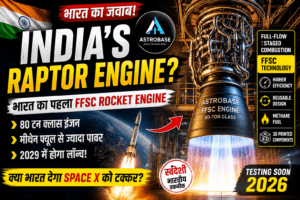
The Astrobase FFSC Engine represents a historic milestone for India’s private space industry, introducing one of the world’s most advanced rocket engine cycles to the country.
The global space race is undergoing a massive paradigm shift. We are rapidly moving away from an era dominated exclusively by government space monopolies to one fueled by hyper-innovative, agile private enterprises. While Western companies like SpaceX have historically captured the lion’s share of international headlines with their cutting-edge reusable propulsion technology, a quiet but fierce engineering revolution is brewing within the Indian private space ecosystem.
In a historic development for indigenous aerospace engineering, Bengaluru-based aerospace startup Astrobase Space Technologies is on the verge of unveiling India’s first fully integrated 80-ton-class Full-Flow Staged Combustion (FFSC) rocket engine. With its Liquid Oxygen (LOX) powerhead hardware already mounted on the test stand for hot-fire preparations at their Anantapur test facility, India is officially entering the elite tier of advanced, reusable space propulsion.
What is an FFSC Engine, and Why is it the Holy Grail of Rocket Science?
To understand the magnitude of what Astrobase is achieving, it is vital to understand the engineering complexities behind a Full-Flow Staged Combustion (FFSC) cycle. In the world of rocket science, the architecture of an engine determines a rocket’s payload capacity, efficiency, and cost-effectiveness.
In conventional liquid-propellant rocket engines (like gas-generator cycles), a small portion of the fuel and oxidizer is diverted and burned prematurely just to power the turbopumps. This exhaust gas is then dumped overboard, essentially wasting potential energy and reducing overall efficiency.
The FFSC cycle, however, turns this traditional method on its head. It channels the entire volume of both the oxidizer and the fuel through separate pre-burners to drive their respective turbopumps before they combine inside the main combustion chamber.
This ultra-complex configuration unlocks two massive advantages:
- Maximum Thermodynamic Efficiency: Because 100% of the propellants pass through the turbopumps and enter the main chamber, it produces significantly higher chamber pressures. Higher pressure equals more thrust from less fuel.
- Drastically Extended Engine Lifespan: In a full-flow system, the turbines run cooler because a massive volume of gas passes through them. Lower thermal stress prevents the internal components from degrading, making the engine highly reliable for multiple consecutive flights.
To date, this highly sophisticated architecture is famously utilized by SpaceX’s Raptor engines, which power the colossal Starship. Astrobase’s successful development of this technology places Indian private aerospace firmly on the global cutting edge alongside the world’s most advanced aerospace giants.
State-of-the-Art Infrastructure: Built Indigenously in India
A technological leap of this magnitude cannot happen in a vacuum; it requires heavily self-reliant infrastructure. Astrobase has systematically invested in establishing robust, end-to-end design, assembly, and testing capabilities entirely within Indian borders. The startup currently operates two crucial, state-of-the-art facilities:
- The Anantapur Test Facility (Andhra Pradesh): Spanning a massive 21.5 acres, this specialized propulsion test facility is engineered to handle extreme thrust levels of up to 200 tons (2,000 kN). It is here that the LOX powerhead—the critical oxidizer-side subsystem of the FFSC engine—is currently undergoing rigorous preparations for its hot-fire trials.
- The Bengaluru Integration Plant (Karnataka): Complementing their test site, Astrobase maintains a 46,000-square-foot assembly and integration facility in India’s tech hub. This allows their engineering teams to manage everything from initial 3D design to precision component manufacturing and final engine integration under one roof.
Disruptive Innovation: Liquid Methane and 3D Printing
Astrobase’s forward-thinking engineering philosophy is further highlighted by its choice of fuel and manufacturing methods.
Unlike traditional rockets that rely on highly polluting refined kerosene (RP-1), Astrobase is leveraging Liquid Methane (Methalox) as its primary fuel source. Methane is rapidly becoming the gold standard for modern spaceflight because it burns incredibly clean. It leaves virtually zero soot or carbon residue inside the intricate pathways of the turbopumps and combustion chambers. This clean-burning property is absolutely vital for rapid turnaround times and rocket reusability.
Additionally, Astrobase utilizes advanced industrial 3D-printing (Additive Manufacturing) to fabricate the core components of its 80-ton engine. 3D printing eliminates the need for complex, time-consuming traditional tooling. It enables the company’s engineers to iterate designs in days rather than months, substantially lowering manufacturing costs while maximizing structural integrity.
Government Validation: The Competitive IN-SPACe Endorsement
Building an advanced rocket engine requires massive capital and strict regulatory compliance. Recognizing the disruptive potential of Astrobase’s propulsion program, IN-SPACe (Indian National Space Promotion and Authorization Centre), the country’s autonomous space regulator, formally backed the startup under its highly competitive Technology Adoption Fund.
The selection process was incredibly demanding. Out of a massive pool of 47 aerospace applicants nationwide, Astrobase underwent a rigorous, year-long technical evaluation. Following this deep-dive audit of their real-world infrastructure and engineering roadmaps, the regulator selected Astrobase as one of only three firms to receive financial and technical backing.
The support agreement, signed in June 2026, directly ties government funding to clearly defined technical milestones. This structure ensures strict accountability while validating that the startup’s tech is entirely viable for commercial deployment.
Road to the Cosmos: Key Milestones and the 2029 Orbital Launch
Astrobase has been systematically hitting its developmental milestones with pinpoint accuracy:
- September 2025: Successfully executed sub-scale hot-fire tests, validating the foundational physics and design principles of their FFSC cycle.
- January 2026: Conquered one of the most demanding hurdles in rocket science by completing successful high-speed turbopump testing under realistic pressure loads.
- Late 2026 (Upcoming): The team is currently rolling out the full-scale integrated 80-ton engine for its definitive hot-fire trials and static stage fire tests.
- 2029 Target: The ultimate culmination of this program is set for 2029, the target year for the maiden orbital launch of Astrobase’s proprietary medium-lift launch vehicle. This rocket will be powered by a heavy-duty cluster of seven integrated FFSC engines firing in unison.
Fueling India’s $44 Billion Space Ambitions
The Indian government has laid out a bold national vision to scale its domestic space economy to a staggering $44 billion by 2034. While the Indian Space Research Organisation (ISRO) continues to pioneer monumental deep-space scientific missions like Chandrayaan and Gaganyaan, the aggressive rise of private players like Astrobase ensures that India will possess sovereign, hyper-competitive, and highly commercial access to low Earth orbit and beyond.
By mastering and commercializing the world’s most advanced rocket architecture entirely on Indian soil, Astrobase is sending a clear message to the international community: the future of affordable, sustainable, and revolutionary space exploration isn’t just being written in Silicon Valley—it is being proudly engineered in India.
** Also view in youtube – https://youtu.be/sosOiI9ld-Y


