
Download PDF: A Combination of Techniques Leads to Improved Friction Stir Welding
The NESC developed several innovative tools and techniques during an assessment to find the root cause of poor tensile strength and low topography anomalies (LTA) in welds formed using a solid-state welding process called self-reacting friction stir welding (SRFSW).
Using a combination of machine learning, statistical modeling, and physics-based simulations, the assessment team helped improve the weld process and solve both issues, lifting constraints that had been placed on flight hardware.
Developing Techniques for LTA Detection
Determining the root cause of poor tensile strength welds and LTA observed on the weld fracture surfaces involved several techniques:
- Deep Learning for LTA Detection: The NESC team developed a machine-learning model to detect and segment LTA in weld images. The model was trained on images annotated by metallurgy experts, with a majority-vote consensus to resolve disagreements. The team then developed an accompanying standard operating procedure for image capture to improve robustness and reduce bias. This model was built on previous NASA work to develop specialty microscopy analysis foundation models by pretraining on 100,000+ microscopy images. This step was crucial to linking process parameters with LTA occurrence in an objective, nonbiased way.
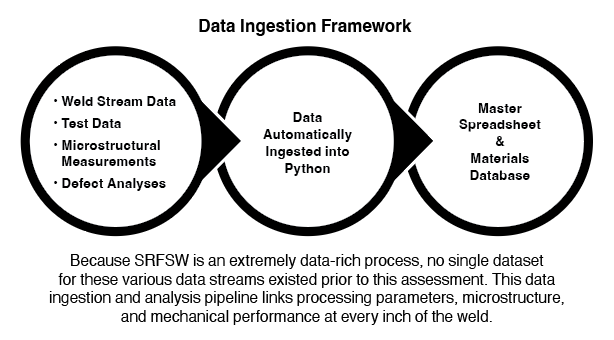
- Integrated Data-Ingestion Framework: SRFSW is a complex process with many interacting variables. The weld process produces a large amount of data with diverse data types that include dozens of tabular process parameters, dozens of sequential data streams from the production tool, fracture and weld cross-section images, and mechanical-test lab data. A Python-based framework was developed to automatically ingest and validate these diverse data and compile them into a single master spreadsheet and a database. This tool reduced manual effort, minimized transcription errors, and improved data quality for downstream analysis. The team delivered the tool to stakeholders for their ongoing use.
- Data Analysis Web Application: A new web-based visualization and analysis tool allowed engineers and subject matter experts to quickly explore the integrated dataset for faster hypothesis testing and more intuitive insight generation throughout the investigation
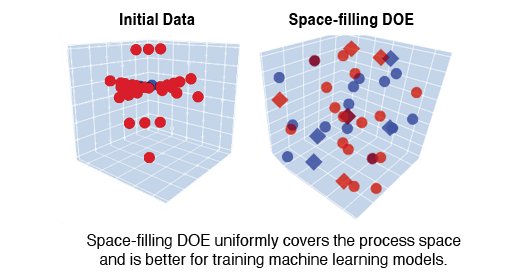
- Space-Filling Design of Experiments: Because SRFSW involves complex, nonlinear relationships between process parameters, the team found traditional factorial designs were insufficient and implemented a space-filling design of experiments (DOE) to efficiently explore the full parameter space. These data-trained machine-learning models capture the underlying weld behavior. The team also developed a software tool for generating such designs and shared it with stakeholders.
- Physics-Based SRFSW Simulation: Creating a computational model of the SRFSW process simulated weld conditions, microstructure evolution, and resulting properties, offering insight into aspects of the weld process that are inaccessible to physical sensors. This enhanced understanding and guided improvements.
Determining LTA Root Cause
Using these tools and analyses, the team identified two root causes for the LTA and poor tensile strength:
- Overly aggressive post-weld surface preparation in production reduced weld strength.
- Weld power input outside the optimal range led to inconsistent welds and increased risk of LTA.
The process models helped define a target weld power input window and recommended how to adjust primary control parameters to reliably achieve that target. Follow-up production tests confirmed that these adjustments could be implemented with high precision, eliminating both low-strength welds and LTA.
Friction Stir Welding
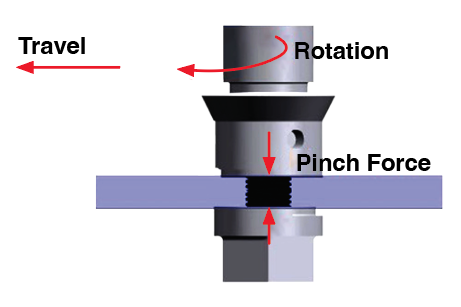
In SRFSW, a rotating pin is plunged into the seam between two metal plates, generating heat through friction that fuses the sheets together without melting the material. This technique produces stronger joints than traditional welding and enables the use of high-performance but traditionally non-weldable alloys like Aluminum 2219.
The SRFSW technique uses no blowtorches or solder because friction stirs the materials together at a molecular level.
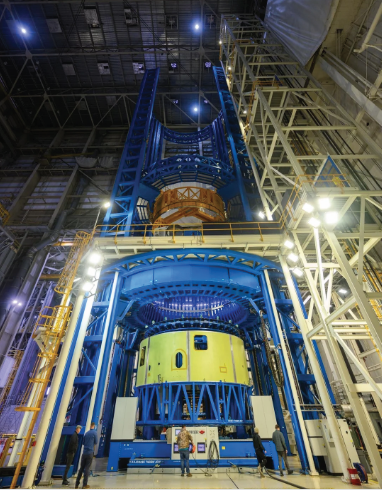
NASA’s Friction Stir Welding lab resides inside NASA’s Michoud Vertical Assembly Center in New Orleans and is being used to join major components of the SLS rocket.
For information, contact Donald S. Parker. donald.s.parker@nasa.gov
References: NASA/TM-20240016466 and NASA/TM-20230010624

