
The recent Gaganyaan Safety Tests mark a major milestone in India’s journey toward independent human spaceflight capability.
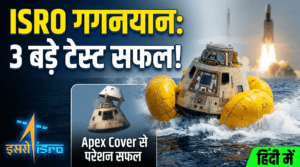
The Indian Space Research Organisation (ISRO) has taken a monumental leap forward in its quest to send humans into space. On Sunday, July 12, 2026, the space agency successfully executed three critical, high-stakes system-level tests for its premier human spaceflight initiative, the Gaganyaan Mission.
These tests did not just mark another checkbox on a long engineering list; they validated the core safety architecture designed to keep Indian astronauts—called Gaganauts—alive during the most perilous phases of flight: atmospheric re-entry, descent, and ocean splashdown.
Here is a comprehensive, deep-dive technical breakdown of the three major systems tested, how they work, and why this brings India remarkably close to achieving autonomous human spaceflight capability.
The Core Mission Architecture: What is at Stake?
The overarching objective of the Gaganyaan programme is straightforward yet incredibly complex to execute: safely launch a crew of Indian astronauts into a Low-Earth Orbit (LEO), sustain them in the harsh environment of space, and safely return them to Earth.
The return journey is arguably the most dangerous part of any human space mission. Traveling at orbital velocities, the spacecraft must encounter the dense friction of Earth’s atmosphere, slow down from thousands of kilometers per hour to a safe landing speed, deploy parachutes, and land in the sea.
To pull this off seamlessly, ISRO divides the spacecraft into two primary components:
-
The Crew Module (CM): The pressurized capsule where the astronauts reside during the journey.
-
The Service Module (SM): The unpressurized section containing the propulsion systems, fuel tanks, and solar panels necessary to power and steer the spacecraft while in orbit.
The three breakthrough tests completed by ISRO validate the exact sequence of events required to separate these modules, deploy parachutes, and stabilize the capsule after landing.
1. The Crew Module Up-righting System: Surviving the Sea Splashdown
When the Gaganyaan capsule returns to Earth, it is designed to land in the ocean—an event known as a “splashdown”. However, the ocean is an unpredictable environment. Strong waves, turbulent winds, and the physical impact of hitting the water can cause the capsule to capsize or tilt upside down upon landing.
If a crew module remains inverted (upside down) in the water, it presents a life-threatening scenario:
-
The communication antennas could be submerged, cutting off contact with recovery teams.
-
The emergency hatches could end up underwater, preventing safe egress or ventilation.
-
The astronauts would be left hanging upside down in their seats, compounding post-landing physical stress.
The Solution: Cold-Gas Flotation
To counter this, ISRO engineers developed a highly sophisticated, stored cold-gas-based up-righting system.
During the qualification test setup realized by ISRO, engineers simulated a system-level deployment. The architecture relies on high-pressure bottles filled with compressed gas. Upon splashdown, onboard control valves automatically trigger, instantly channeling the high-pressure gas into specialized flotation bags built into the top structure of the crew module.
The successful inflation test proved that even if the capsule experiences extreme tilting or capsizes upon hitting the sea, the flotation system exerts enough buoyant force to automatically flip the crew module back into its correct vertical orientation. This ensures the safety of the astronauts while they await extraction by naval rescue teams.
2. Service Module Connect-Disconnect System: Clean Re-entry Separation
During its time in orbit, the Crew Module and Service Module act as a single, unified spacecraft linked together by an umbilical mechanism. This umbilical connection provides power, data links, life-support fluids, and propulsion control from the Service Module to the Crew Module.
However, the Service Module does not have a heat shield and is not designed to survive atmospheric re-entry. Before entering the Earth’s atmosphere, the two modules must cleanly disconnect. If they fail to separate, or if the separation is messy, the Service Module could collide with the Crew Module, damaging its thermal protection tiles and causing a catastrophic structural failure during re-entry.
The CSU-1 and CSU-2 Mechanism
ISRO’s connect-disconnect mechanism features a two-part separation design:
-
CSU-1: Located structurally on the Crew Module side.
-
CSU-2: Located on the Service Module side.
During the actual re-entry sequence, the separation happens in a carefully timed, multi-stage process. First, CSU-1 disconnects to isolate core lines, initiating the physical drift between the modules. Just prior to entering the dense layers of the atmosphere, CSU-2 is completely separated.
ISRO carried out a rigorous separation test of the CSU-2 assembly using a simulated crew module platform. The test yielded flawless data, confirming a clean separation. More importantly, it verified the structural stability of the crew module panel and its interfaces under the sudden mechanical stress of breaking the connection, ensuring that no structural deformation occurs when the modules disengage in real-time space conditions.
3. The Apex Cover Separation Event: Unleashing the Parachutes
The final line of defense against gravity is the Crew Module’s parachute system. Because the module falls at terminal velocity through the atmosphere, massive parachutes must deploy to slow the craft down to a gentle speed before it impacts the water.
However, during the initial re-entry phase, these parachutes are highly vulnerable. The extreme friction with atmospheric air generates temperatures climbing to thousands of degrees Celsius. To protect the parachutes and their mechanical deployment mortars from this intense heat, ISRO seals them under a protective shield at the top tip of the capsule, known as the Apex Cover.
The Precision Timing of the Separation
The Apex Cover must stay firmly attached during the hottest part of re-entry. But once the capsule slows down to a safe speed and altitude, this cover must be instantly blasted away to expose the parachute bay. If the apex cover fails to separate, the parachutes cannot deploy, leading to a high-velocity impact with the ocean.
ISRO’s third test focused extensively on this apex cover separation event. Using pyro-actuated or mechanical separation mechanisms, the test validated that the cover can be jettisoned cleanly. The data confirmed the structural integrity of the crew module throughout the separation shock wave, guaranteeing that the protective lid flies clear off the vehicle without colliding with the module or interfering with the subsequent deployment sequence of the parachutes.
Why These Successes Build a Layered Safety Architecture
Spaceflight is inherently dangerous, and human spaceflight leaves absolutely zero margin for error. Rather than relying on a single safety protocol, ISRO has constructed what is known as a layered safety architecture.
Each of the three mechanisms tested on July 12, 2026, forms a vital, interconnected pillar of this safety net:
| Tested System | Primary Safety Function | Mission Phase |
| Apex Cover Separation | Safely exposes the parachute bay without damaging the module. | Late Descent Phase |
| Connect-Disconnect System (CSU-2) | Ensures clean, collision-free separation from the Service Module. | Re-entry Initiation |
| Up-righting Flotation System | Forces the capsule into an upright position in choppy seas. | Post-Splashdown / Recovery |
Together, these validations mean that from the moment the capsule decides to come home to the moment the astronauts step out onto a rescue boat, every mechanical transition has been proven stable and reliable.
What Lies Ahead for India’s Gaganyaan Program?
With the successful completion of these three foundational tests, ISRO has cleared major engineering roadblocks. The confidence gained from these results will directly feed into the upcoming uncrewed test flights.
These uncrewed missions will act as the ultimate proving grounds, flying the exact hardware and automated software configurations into orbit and bringing them back to Earth without a human crew onboard. Once those automated end-to-end missions mirror the perfection seen in these standalone system tests, India will officially join an elite group of nations—currently consisting only of the United States, Russia, and China—possessing independent human spaceflight capability.
The dream of seeing an Indian rocket carry Indian citizens from Indian soil into the cosmos is no longer a distant vision; it is a reality unfolding one successful test at a time.
** Also View In Youtube – https://youtu.be/GQqyO6Jig_A

