
India’s ASTRA High-Speed Drone Interceptor: A New Era in Counter-Drone Warfare
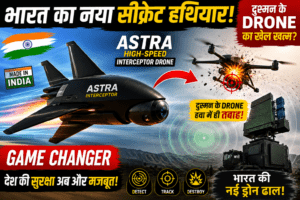
The battlefield is evolving rapidly. Modern wars are no longer dominated solely by fighter jets, battle tanks, artillery, or long-range missiles. Instead, small, fast, and highly capable unmanned aerial vehicles (UAVs)—commonly known as drones—have emerged as one of the most disruptive technologies in military operations.
Over the past few years, conflicts across the globe have demonstrated how inexpensive drones can perform reconnaissance, deliver explosives, conduct precision strikes, and gather intelligence with remarkable efficiency. These developments have forced nations to rethink traditional air defence strategies and invest heavily in technologies capable of neutralizing drone threats quickly and economically.
Recognizing this growing challenge, India is strengthening its indigenous defence capabilities through innovative startups and private defence companies. One such development is the ASTRA High-Speed Drone Interceptor, an indigenous counter-drone solution designed to detect, pursue, and intercept hostile drones before they can reach their targets.
Although detailed technical specifications have not yet been officially released, the project represents another important milestone in India’s rapidly expanding defence technology ecosystem and highlights the country’s commitment to Atmanirbhar Bharat and Make in India initiatives.
Why Counter-Drone Technology Has Become Essential
Drone technology has revolutionized military operations because of its affordability, versatility, and operational efficiency.
Unlike traditional combat aircraft, drones are comparatively inexpensive, easier to deploy, and capable of operating in environments where sending human pilots would be risky. They can carry cameras, sensors, electronic warfare payloads, or even explosive devices depending on their intended mission.
This has created entirely new security challenges.
Today, hostile drones are increasingly used for:
- Border surveillance
- Intelligence gathering
- Weapon delivery
- Smuggling of arms and narcotics
- Infrastructure monitoring
- Coordinated swarm attacks
- Electronic warfare support
Countries around the world are investing billions in Counter-UAV (C-UAV) technologies because conventional air defence systems are often not designed to engage small, low-flying drones efficiently.
Launching expensive surface-to-air missiles against inexpensive drones is rarely cost-effective. This has created demand for faster, smarter, and more economical interception systems capable of neutralizing UAV threats before they cause damage.
India’s Growing Counter-Drone Ecosystem
India has significantly accelerated indigenous defence development during the past few years.
Government initiatives such as Make in India, Atmanirbhar Bharat, and increased participation from private startups have transformed India’s defence manufacturing landscape.
Today, Indian companies are developing:
- AI-powered surveillance drones
- Swarm drone technologies
- Loitering munitions
- Autonomous UAV systems
- Counter-drone radar
- Electronic warfare solutions
- Anti-drone jammers
- Drone detection sensors
- Interceptor drones
The emergence of indigenous startups working alongside established defence organizations is reducing India’s dependence on imported defence equipment while promoting domestic innovation.
The ASTRA High-Speed Drone Interceptor is another example of this growing ecosystem.
What Is the ASTRA High-Speed Drone Interceptor?
The ASTRA High-Speed Drone Interceptor is an indigenous drone interception platform currently being developed to address one of the fastest-growing threats in modern warfare—the hostile UAV.
Unlike conventional surveillance drones whose primary role is observation, the interceptor is intended to actively pursue and stop unauthorized drones operating in protected airspace.
Its primary objectives include:
- Detecting hostile drones
- Rapid pursuit of aerial targets
- Autonomous interception
- Protection of sensitive military zones
- Enhancing layered air defence
While the company has not publicly disclosed complete technical specifications such as speed, operational range, payload capacity, endurance, or interception mechanism, the concept itself reflects a growing global trend toward dedicated aerial interception platforms.
This approach offers several operational advantages over conventional missile-based responses, particularly when dealing with low-cost drones.
How Could an Interceptor Drone Work?
Although ASTRA has not released full operational details, interceptor drones generally follow a multi-stage engagement process.
1. Threat Detection
The first step involves identifying an unauthorized UAV entering protected airspace.
Detection may involve multiple systems including:
- Ground-based radar
- Electro-optical cameras
- Infrared sensors
- RF detection equipment
- AI-assisted tracking software
These systems continuously monitor surrounding airspace and generate alerts whenever suspicious aerial activity is detected.
2. Target Tracking
Once a drone has been detected, sophisticated tracking algorithms calculate its:
- Direction
- Speed
- Flight path
- Altitude
- Estimated destination
Continuous tracking ensures that the target remains under observation even if it changes direction or altitude.
Artificial intelligence can significantly improve tracking accuracy by predicting future movement patterns.
3. High-Speed Pursuit
The interceptor drone is then launched toward the hostile UAV.
Unlike surveillance drones optimized for endurance, interceptor drones emphasize:
- Rapid acceleration
- High maneuverability
- Fast response time
- Precise navigation
Their objective is to minimize interception time before the hostile drone reaches its intended target.
4. Neutralization
The final interception phase has not been officially disclosed for the ASTRA platform.
Globally, interceptor drones may neutralize threats using various methods depending on system design, including physical interception, entanglement systems, or other specialized counter-UAV techniques. Since ASTRA has not publicly confirmed its approach, it is important not to assume any specific interception mechanism.
This cautious approach ensures that only verified information is considered while the platform continues its development.
Why This Development Matters
India shares long and sensitive borders where drone-related incidents have become an increasing security concern. Unauthorized UAVs have been linked to surveillance activities, attempted smuggling operations, and other cross-border security challenges.
An indigenous high-speed interceptor could eventually become an important component of a broader layered air defence strategy by enabling faster responses to low-altitude aerial threats while reducing reliance on expensive missile systems.
Such capabilities may prove valuable for protecting:
- Military bases
- Air force stations
- Ammunition depots
- Border outposts
- Critical infrastructure
- Oil refineries
- Nuclear facilities
- Airports
- Government installations
As drone technology continues to evolve, counter-drone platforms like ASTRA could play a growing role in strengthening India’s national security posture.
Potential Applications of the ASTRA High-Speed Drone Interceptor
As drone technology becomes more accessible, the need for reliable counter-drone systems is increasing across military, government, and civilian sectors. While the ASTRA High-Speed Drone Interceptor is primarily intended for defence applications, its potential use cases extend far beyond traditional battlefields.
Protecting International Borders
India has one of the world’s longest and most complex land borders. Security agencies continuously monitor these areas for unauthorized aerial activity that may involve surveillance, smuggling, or other illegal operations.
A high-speed interceptor drone could become an additional layer of border security by responding quickly to suspicious UAVs before they reach sensitive locations.
Instead of relying only on radar alerts, security personnel could deploy interceptor drones capable of rapidly approaching a detected target and attempting to stop its mission.
Military Base Protection
Modern military bases contain aircraft, ammunition depots, communication systems, radar installations, and command centres that require constant protection.
Small drones can potentially gather intelligence or disrupt operations if they enter restricted airspace.
A dedicated interceptor platform could strengthen base security by providing a fast aerial response to low-altitude drone threats that conventional air defence systems may not be optimized to address.
Safeguarding Critical Infrastructure
Beyond defence installations, India operates numerous strategic assets that require enhanced aerial security.
These include:
- Nuclear power facilities
- Hydroelectric projects
- Oil and gas refineries
- LNG terminals
- Ports
- International airports
- Power generation stations
- Government buildings
- Satellite communication centres
As drone technology becomes more common, protecting these locations will likely require multiple layers of surveillance and interception capabilities.
Countering Swarm Drone Threats
One of the biggest emerging challenges in modern warfare is the use of drone swarms.
Instead of deploying a single UAV, attackers may launch dozens of coordinated drones simultaneously to overwhelm traditional defence systems.
Although no official information suggests that ASTRA is specifically designed for swarm interception, future counter-drone ecosystems may combine interceptor drones with AI-powered radar, electronic warfare systems, and autonomous command software to improve responses against multiple airborne threats.
The Rise of India’s Defence Startup Ecosystem
For decades, India’s defence manufacturing sector relied heavily on imports for advanced technologies.
That landscape is gradually changing.
Government initiatives encouraging indigenous innovation have created opportunities for startups to contribute to national defence projects.
Today, Indian private companies are actively working on technologies such as:
- Artificial Intelligence
- Autonomous robotics
- Advanced UAVs
- Electronic warfare
- Radar systems
- Navigation software
- Smart sensors
- Military communication
- Cybersecurity
- Autonomous vehicles
This shift represents more than technological progress—it reflects a strategic effort to strengthen India’s domestic defence manufacturing capabilities while reducing dependence on foreign suppliers.
Projects like the ASTRA High-Speed Drone Interceptor demonstrate how startups are becoming important contributors to the country’s defence innovation ecosystem.
Why Indigenous Defence Technology Matters
Developing defence technologies within the country offers several long-term advantages.
Reduced Import Dependency
Imported defence systems often involve lengthy procurement processes, higher costs, licensing restrictions, and maintenance dependencies.
Indigenous development helps reduce these challenges while strengthening domestic manufacturing capabilities.
Faster Customization
Indian defence requirements differ significantly from those of many other countries.
Systems developed locally can be adapted more easily to:
- Desert environments
- Himalayan terrain
- Coastal regions
- High-altitude operations
- Tropical climates
This flexibility allows developers to respond more effectively to operational feedback from Indian security agencies.
Strengthening Strategic Independence
Self-reliance in defence technology reduces vulnerability to geopolitical uncertainties and export restrictions.
Domestic innovation also supports long-term modernization programs while creating opportunities for future exports.
Economic Growth
The growth of defence startups contributes to:
- High-skilled employment
- Research and development
- Manufacturing investments
- Technology exports
- Startup ecosystem expansion
As India’s defence industry grows, these innovations may also generate civilian applications in robotics, artificial intelligence, automation, and aerospace engineering.
Challenges Ahead
Although the development of indigenous interceptor drones is encouraging, several challenges remain before such systems can achieve large-scale operational deployment.
Extensive Testing
Every defence platform undergoes rigorous testing under multiple environmental conditions before operational induction.
Interceptor drones must demonstrate reliability across varying weather conditions, terrain, communication environments, and operational scenarios.
Integration with Existing Defence Networks
Modern military operations depend on interconnected command-and-control systems.
Future counter-drone platforms may need seamless integration with:
- Radar networks
- Air defence systems
- Surveillance infrastructure
- Battlefield management systems
- Electronic warfare assets
Such integration requires extensive validation and interoperability testing.
Evolving Drone Threats
Drone technology continues to evolve rapidly.
Potential adversaries are developing UAVs with:
- Greater speeds
- Lower radar signatures
- Autonomous navigation
- AI-assisted flight
- Electronic countermeasures
Counter-drone technologies must therefore continue evolving to remain effective against future threats.
India’s Road Ahead in Counter-Drone Warfare
India is investing heavily in next-generation defence technologies, including artificial intelligence, robotics, autonomous systems, advanced sensors, and electronic warfare.
The ASTRA High-Speed Drone Interceptor represents one example of this broader modernization effort.
As additional indigenous technologies mature, India could build an integrated counter-drone ecosystem consisting of:
- Drone detection radar
- Electro-optical surveillance
- Radio-frequency detection systems
- Electronic jamming equipment
- AI-assisted command software
- High-speed interceptor drones
- Multi-layered air defence coordination
Such a network would enhance situational awareness while providing multiple options for responding to unauthorized aerial threats.
Expert Perspective
The growing importance of drones in modern warfare has fundamentally changed military planning worldwide.
Rather than relying solely on traditional air defence systems, many countries are adopting layered counter-drone strategies that combine surveillance, electronic warfare, interception platforms, and artificial intelligence.
India’s focus on indigenous innovation aligns with this global trend.
Although complete technical details of the ASTRA High-Speed Drone Interceptor have not yet been publicly released, the project highlights the increasing role of Indian startups in developing advanced defence technologies.
As official testing, validation, and operational information become available, the platform’s capabilities and future deployment potential will become clearer.
Drone warfare is no longer a concept of the future—it is a defining feature of modern conflicts. From surveillance missions to precision strikes, UAVs have transformed how nations approach security and military operations.
To address these evolving threats, countries are investing in smarter and more cost-effective counter-drone technologies. India’s ASTRA High-Speed Drone Interceptor reflects this strategic direction by demonstrating the country’s commitment to indigenous defence innovation.
While many technical specifications remain undisclosed, the project itself represents an important step toward strengthening India’s counter-UAV capabilities under the Make in India and Atmanirbhar Bharat initiatives.
If successfully developed, tested, and integrated into India’s broader defence architecture, interceptor drones like ASTRA could enhance the protection of military installations, critical infrastructure, and border regions against emerging aerial threats.
The coming years will determine how such indigenous platforms evolve, but one thing is already evident: India’s defence startup ecosystem is playing an increasingly significant role in shaping the future of national security.
❓FAQ (Frequently Asked Questions)
What is the ASTRA High-Speed Drone Interceptor?
The ASTRA High-Speed Drone Interceptor is an indigenous counter-drone platform being developed to detect, pursue, and intercept unauthorized UAVs. Public technical specifications remain limited.
Why are interceptor drones important?
Interceptor drones provide a faster and potentially more cost-effective response to small UAV threats than using conventional air-defence missiles alone.
Has the Indian government released all technical specifications?
No. As of now, detailed information such as speed, range, payload, and interception method has not been officially disclosed.
How could interceptor drones strengthen India’s security?
They could enhance protection for military bases, border regions, airports, ports, power plants, and other critical infrastructure against unauthorized drone activity.
Is this technology part of Make in India?
The project reflects India’s broader emphasis on indigenous defence innovation and aligns with the goals of the Make in India and Atmanirbhar Bharat initiatives.
and other critical infrastructure against unauthorized drone activity.

