
India has taken another significant step forward in advanced space propulsion with the successful flight acceptance test of the CE20 cryogenic engine designated for the upcoming LVM3-M7 mission. The achievement underscores the growing maturity of the country’s indigenous heavy-lift launch capabilities and its readiness for future scientific, human-spaceflight, and commercial endeavors.
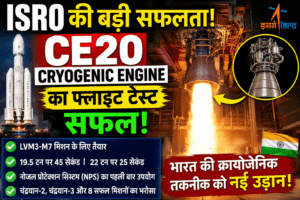
The CE20 engine powers the upper stage of the LVM3 launch vehicle, India’s most powerful operational rocket. Designed and built entirely within the country, the engine operates on liquid hydrogen and liquid oxygen, propellants that offer exceptional efficiency but require sophisticated handling due to their extremely low storage temperatures. Mastery of cryogenic propulsion is considered a hallmark of advanced spacefaring nations, making the CE20 program a major technological accomplishment for India.
Over the past several years, the engine has established an impressive record of reliability, supporting a series of successful LVM3 missions that include lunar exploration campaigns and commercial satellite launches. Its proven performance has also enabled it to satisfy the demanding standards required for human-rated missions, paving the way for its role in the Gaganyaan program.
A notable aspect of the latest acceptance test was the first operational use of the newly developed Nozzle Protection System (NPS). This innovation allows the engine, equipped with its full-area-ratio nozzle, to be tested safely under sea-level conditions. By reducing dependence on complex high-altitude test setups, the system streamlines operations, conserves resources, and permits longer-duration evaluations.
The hot test, conducted on 6 July 2026 at the ISRO Propulsion Complex in Mahendragiri, demonstrated the engine’s ability to perform across its operational envelope. The engine successfully operated at intermediate and full thrust settings, while the NPS functioned exactly as intended. The positive outcome confirms the readiness of both the propulsion system and the supporting test infrastructure for upcoming missions.
Following final inspections and refurbishment, the engine will be integrated into the C32 cryogenic stage for the LVM3-M7 flight. Beyond preparing a single mission, this milestone strengthens the foundation for India’s future lunar expeditions, human spaceflight ambitions, and participation in the global launch market.
The successful qualification of the CE20 engine and its associated technologies highlights the steady progress of India’s space program. As indigenous expertise in cryogenic propulsion continues to expand, the nation is increasingly well positioned to undertake more ambitious exploration missions and provide reliable launch services to customers around the world.
** Watch This video on Youtube – https://youtu.be/CAVdjKFzfdU

