
ISRO’s Successful 175 Ton Semi-Cryogenic Engine Test Marks a Historic Leap Towards Future Moon Missions
India has once again demonstrated its growing technological strength in space exploration. The Indian Space Research Organisation (ISRO) has successfully completed the hot test of its indigenous Semi-Cryogenic Engine Power Head at an impressive 175 tonnes of thrust, marking one of the most significant propulsion achievements in the country’s space program.
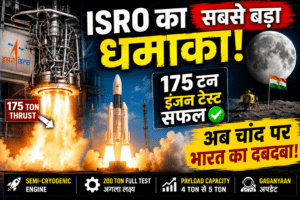
Conducted on 24 June 2026 at the ISRO Propulsion Complex in Mahendragiri, Tamil Nadu, this successful test validates nearly 90 percent of the engine’s designed performance and brings India much closer to deploying the next generation of heavy-lift launch vehicles.
This breakthrough is expected to play a vital role in future Moon missions, Gaganyaan, deep-space exploration, commercial satellite launches, and India’s long-term ambitions as a global space power.
What Was Tested?
The test involved the Power Head Test Article, one of the most critical components of the Semi-Cryogenic Engine.
Unlike a complete engine test, the power head excludes the thrust chamber while integrating several key systems, including:
- Gas Generator
- Turbo Pumps
- Pre-Burner
- Control Systems
- Propellant Feed System
Testing these components together allows ISRO engineers to verify whether the engine’s core systems perform correctly under near-operational conditions.
The result exceeded expectations, with every parameter remaining within the predicted operating range throughout the test.
Why Semi-Cryogenic Engines Matter
The new engine represents a major technological upgrade over conventional liquid propulsion systems.
Instead of using traditional propellants, ISRO’s Semi-Cryogenic Engine burns:
- Liquid Oxygen (LOX) as the oxidizer
- ISRO-developed refined kerosene called Isrosene as fuel
This combination provides several important advantages.
Higher Performance
Semi-cryogenic engines generate greater thrust while consuming fuel more efficiently.
Lower Cost
The propellants are significantly more economical, reducing overall launch expenses.
Cleaner Technology
Isrosene produces lower toxicity and better combustion efficiency compared with conventional fuels.
Higher Reliability
The successful operation of the turbo pumps at approximately 400 and 500 bar outlet pressures demonstrates the engine’s robust engineering and readiness for future missions.
The Journey So Far
The 175-ton hot test was the eighth in ISRO’s qualification campaign.
Earlier successful milestones included:
- 94 Ton Test
- 120 Ton Test
- 175 Ton Test
The next major objective is the 200 Ton Full Engine Hot Test, which will include the complete thrust chamber.
Once this final qualification is completed, the engine will be ready for operational use.
Transforming India’s Launch Vehicles
The new propulsion system will power the SC120 Semi-Cryogenic Stage, driven by the SE2000 Engine producing approximately 2000 kN of thrust.
This stage will replace the existing L110 Liquid Core Stage used in Launch Vehicle Mark-3 (LVM3).
The upgrade will significantly improve launch capabilities by:
- Increasing payload capacity
- Reducing launch costs
- Improving mission efficiency
- Supporting larger spacecraft
- Enabling more ambitious planetary exploration missions
Payload capability to Geosynchronous Transfer Orbit is expected to increase from approximately 4 tonnes to nearly 5 tonnes, opening new possibilities for commercial launches and advanced scientific missions.
Gaganyaan Mission Update
ISRO Chairman V. Narayanan also shared encouraging updates on India’s first human spaceflight program.
According to him, the Gaganyaan mission remains one of India’s most technology-intensive projects.
Before astronauts are launched, ISRO plans to conduct:
- Three uncrewed missions
- Complete human-rating certification of the launch vehicle
- Extensive safety verification
Only after these milestones are completed will India’s first astronauts travel into space.
A Step Towards Space Self-Reliance
One of the biggest achievements behind this successful test is technological independence.
Developing an indigenous Semi-Cryogenic Engine reduces India’s dependence on foreign propulsion technologies and strengthens the nation’s long-term strategic capabilities.
Countries with similar heavy-lift propulsion systems include:
- NASA (United States)
- Roscosmos (Russia)
ISRO’s success now places India among the world’s leading spacefaring nations capable of developing advanced rocket propulsion technology.
Looking Ahead
The upcoming 200-ton full-scale hot test will be the final milestone before operational deployment.
Once qualified, India’s next-generation launch vehicles will become more powerful, more economical, and capable of carrying heavier payloads farther into space than ever before.
These advancements will directly support:
- Future Moon Missions
- Deep Space Exploration
- Gaganyaan
- Commercial Launch Services
- Planetary Science Missions
- National Security Space Assets
Final Thoughts
ISRO’s successful 175-ton Semi-Cryogenic Engine hot test is much more than another engineering milestone. It represents India’s determination to achieve complete technological self-reliance in advanced rocket propulsion.
With every successful test, India moves closer to becoming one of the world’s most influential space powers. As preparations begin for the full 200-ton engine test, the future of India’s space program looks brighter than ever.
The journey toward the Moon, deep space, and beyond has entered an exciting new chapter—and ISRO is leading the way.
**** also view in Youtube – https://youtu.be/JUB4LT8Kmo4

