
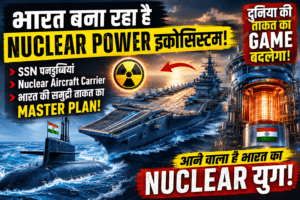
India’s maritime security requirements continue to grow as the strategic environment across the Indian Ocean becomes increasingly competitive. Rather than focusing on a single platform, India has spent years developing a complete ecosystem capable of designing, manufacturing, and supporting nuclear-powered naval vessels.
This long-term effort involves advanced reactor engineering, specialized shipbuilding facilities, nuclear safety systems, high-performance metallurgy, and precision manufacturing. Together, these capabilities form the technological backbone of India’s future naval ambitions.
The Importance of Nuclear Propulsion
Unlike conventional diesel-electric submarines, nuclear-powered submarines can remain underwater for months without surfacing for fuel or battery charging. This significantly enhances operational endurance, stealth, and deployment flexibility.
Nuclear propulsion enables:
- Extended underwater operations
- Higher sustained speeds
- Greater operational range
- Improved survivability
- Continuous strategic deterrence
- Long-duration intelligence missions
These advantages explain why the world’s leading naval powers continue investing heavily in nuclear-powered fleets.
India’s Growing Indigenous Capability
India’s experience in naval nuclear propulsion began with years of research involving scientists, engineers, defence laboratories, and naval experts.
The successful development of indigenous ballistic missile submarines demonstrated India’s ability to design and integrate compact naval reactors while managing highly complex engineering challenges.
This expanding industrial ecosystem reduces dependence on foreign suppliers while strengthening India’s strategic autonomy.
The Next Phase: Nuclear Attack Submarines
Following the development of ballistic missile submarines, attention has increasingly shifted toward nuclear-powered attack submarines, commonly known as SSNs.
Unlike ballistic missile submarines, SSNs focus on:
- Anti-submarine warfare
- Surface fleet protection
- Intelligence gathering
- Escorting aircraft carriers
- Long-range patrol missions
- Strategic surveillance
These submarines provide operational flexibility and remain among the most valuable assets in any modern blue-water navy.
More Than Just Submarines
One of the most significant developments is not a single vessel but the gradual creation of an integrated naval nuclear ecosystem.
This includes:
- Reactor design expertise
- Specialized metallurgy
- Advanced manufacturing
- Nuclear safety infrastructure
- High-precision machining
- Quality assurance systems
- Naval engineering expertise
- Supply-chain development
Such an ecosystem supports multiple generations of naval platforms and enables future technological innovation.
Could Nuclear Aircraft Carriers Become Reality?
Although India has not officially announced plans for a nuclear-powered aircraft carrier, the continued advancement of indigenous reactor technology naturally raises discussions about future possibilities.
Nuclear-powered aircraft carriers offer several advantages:
- Exceptional operational endurance
- Reduced dependence on fuel logistics
- Higher electrical generation capacity
- Greater operational flexibility
- Support for future high-energy systems
- Increased deployment duration
Developing such platforms requires decades of accumulated expertise in naval nuclear engineering, shipbuilding, and systems integration.
India’s current investments in reactor technology and industrial capability could provide valuable experience for any future decisions in this direction.
Strengthening Maritime Security
The Indian Ocean remains one of the world’s most strategically important maritime regions. Secure sea lanes are essential for global commerce, energy transportation, and regional stability.
A technologically advanced navy equipped with modern underwater capabilities enhances maritime surveillance, deterrence, and rapid response during regional contingencies.
Continued investment in indigenous defence technology also supports long-term national security while encouraging domestic innovation and industrial growth.
Indigenous Technology as a Strategic Asset
India’s emphasis on self-reliance extends beyond military capability.
Domestic research organizations, shipyards, engineering companies, and manufacturing industries collectively contribute toward creating advanced technologies within the country.
This approach strengthens:
- National security
- Industrial capability
- Skilled employment
- Technological innovation
- Supply chain resilience
- Export potential
Over time, these investments contribute to a stronger defence manufacturing ecosystem.
Looking Ahead
India’s naval nuclear journey is best understood as the gradual construction of a long-term technological foundation rather than a single defence project.
As indigenous expertise continues to mature, the country is steadily expanding its ability to design sophisticated naval systems, support advanced submarines, and strengthen maritime capabilities.
Whether through future SSNs, next-generation reactors, or other advanced naval platforms, India’s evolving naval nuclear ecosystem represents an important milestone in the nation’s broader maritime modernization strategy.
Conclusion
India’s growing naval nuclear ecosystem reflects decades of scientific research, engineering excellence, and industrial development. Rather than focusing solely on individual platforms, the country is building the technological infrastructure needed to support future maritime capabilities.
As regional security dynamics evolve, continued investment in indigenous innovation, advanced reactor technology, and specialized naval engineering will remain central to India’s long-term maritime strategy.
** Also View in Youtube – https://youtu.be/WQsOeP3X3NI

